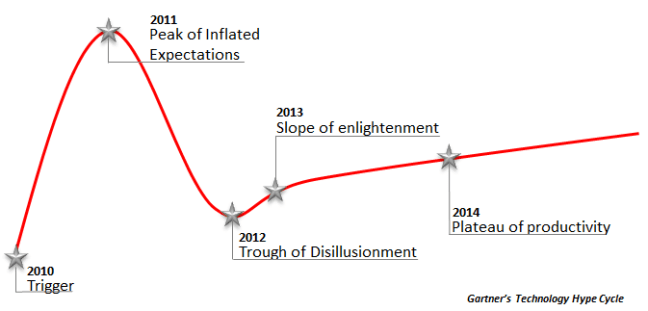
Group Buying enters the Trough of Disillusionment, will it recover?

image

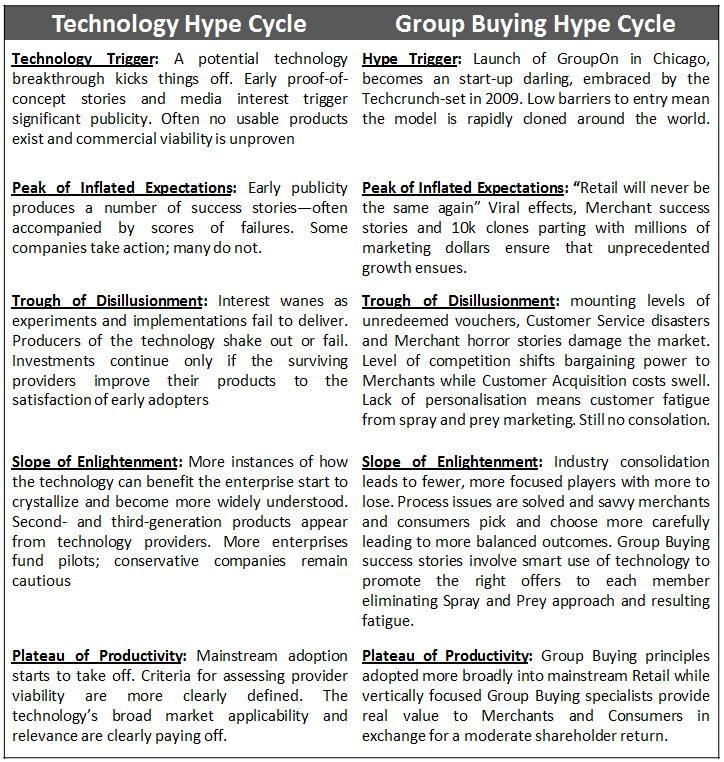
Gartner describes the adoption of Technology (where there has been clear market Hype) using the Hype Cycle diagram. The same diagram can be usefully adapted to describe the current challenges facing the Group Buying industry given it was built on a platform of extraordinary hype and has since suffered its own decline. Also, much like how the Technology Hype Cycle describes the organic adoption of the technology over time once the Hype has dissipated and the useful nature of the innovation emerges, Collective Buying does add real value to Merchants and Consumers, and beyond the hype and the noise of Group Buying, that value add still exists – which then begs an interesting question, what is required to ensure an enduring future for Group Buying?

The key phases of the Gartner Hype Cycle are on the left of the table, an equivalent stage in the Group Buying evolution is on the right:
image

I believe that to get through the Trough of Disillusionment and onto the Slope of Enlightenment, the players in the industry need to follow the 4 tenets of Effective Group Buying:

  1. Provide genuinely useful marketing services for Merchants, including valuable insights on their new customers and mechanisms to drive upsell and loyalty
  2. Minimise the promotion of irrelevant offers through investments in targeting technology
  3. Add Value to their members through genuine discounts on products and services
  4. Underwrite their offers with a suitable customer support policy and helpdesk

The simple rules of getting business referrals

image

Dan Sullivan’s 2005 book, How the Best get Better, contained some simple tips around improving your referability – I thought it would be useful to repeat here.

Four simple rules:

  1. Turn up on time
  2. Do what you say you will do
  3. Finish what you start
  4. Always say please and thank you.

What struck me most about this framework is the absolution simplicity of its guidelines, and the no-brainer nature of the points.

So if the rules of the game are this simple, why publish them here? Tragically these behaviours are atypical – especially rules 1 and 4!

Corporate Risk and the untold impact of Social

image

I spoke at a great business breakfast recently about the impact of social on commerce in Australia and was struck by how traditional businesses can find sound reasoning not to engage in social conversation.

The key objection I heard was around Risk, which is interesting given how big business currently thinks about the notion of Risk.

Risk Management is defined as the identification, assessment and prioritization of risks, coupled with coordinated and economical application of resources to minimize, monitor and control the probability and/or impact of unfortunate events.

Commercial exposure from unfortunate events is inevitable, and in a world of Twitter and Facebook the pace of at which that Risk manifests is astonishing. The viral nature of Social therefore undermines the traditional view of Risk mitigation and damage control – so the first thing big business has to do is acknowledge that the world has already changed, they just haven’t caught up yet.

We know that people have an inherent desire to share, regardless of the sentiment.  If a business has no means to monitor/control the conversation, that’s where the risk exists. And establishing a social platforms early is the only answer.

If your customers are worried, give them a platform to share their concerns, make them feel like they are heard, while you monitor and moderate the conversation. Take some control of the discussion. If they are angry, frustrated or even delighted, give them a platform to engage and share.

There is no reason why the conversation platform you provide can’t operate with strict rules of engagement and therefore the existing risk framework. Sure there are NEW RISKS attached to social engagement, but they exist already, start mitigating these new risks before the unfortunate event you fear most.

Five key truths about Social engagement:

•Your customers will find very effective ways to broadcast “feedback” about you online whether you like it or not

•You can and should measure the sentiment of your target Audience, engage them and give them a platform, Radian6 and People Browsr’s Kred are exceptional platforms

•Monitor and moderate the conversation, but never astrosurf

•Social brings New Risk to business, get used to it!

•It’s prudent to provide a platform BEFORE the event you fear the most happens

The issue I describe here around the inevitability of social engagement is told well by the history of a UK Cable company NTL (now Virgin) and its relationship with a consumer lobby group nthellworld in 2000, worth a read.