This post was written by Boris Gefter – freelance Acquisition Guru and consultant to 57 Signals.
Google analytics (GA) is rubbished more often than not by Omniture diehards and hardcore data analysts. They bleat persistently about their inability to feed GA with non-standard data (outside the scope of what the javascript captures) and readily extract the data (in the way you can with a data cube). But these guys are locked in time, probably still awaiting the arrival of the iPhone 3!GA has evolved in a fantastic way over the past 3 years! In its evolution it has made available rich data to those that care to harness it. But what is more impressive, is how easy and intuitive it is to use the interface and find answers to questions a sophisticated online store owner may ask. But, let me curb my Google appraisals for the time being, lest this blog post be censored by the powers that be. 😉
Jumping right in, here are my three favourite GA features (and there are many!)
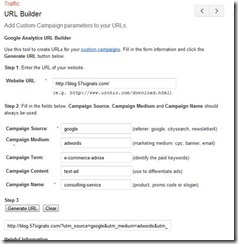
1. Google URL Builder.
A humble servant of GA’s ability to capture and store url parameters. It is surprising how many people do not know that this functionality exists! The standard user will be used to viewing the “Traffic Sources Overview” report, but when you want to know what campaign, keyword, ad or placement on which network and partner has resulted in a sale, coding your own unique URLs could not be easier. Then, when it comes to retrieving this information, you can rely on your friend ‘Custom Reporting’….
2. Custom Reporting:
The humble tab that sits atop the interface is the key to unlocking analytics glory. For those that know and love pivot tables and data cubes, GA has a gift for you. For those that are new to looking at dimensions and metrics, they key is not to be intimidated by the blank canvas. Start playing around, adding metrics (things that are measurable) such as time on page or conversion rate (if you have ecommerce tracking enabled) is really easy. Dimensions (what describes the data) can be configured to retrieve information that you coded into the Google URL builder in step two, by adding “Source” and “medium” alongside the metrics you are interested in.

As an example, say you wanted to find out how successful your google adwords campaigns are (which you had already coded with the url tool, as seen above), you can simply add source as one of your dimensions and the relevant metrics such as visits and number of transactions as shown in this example. Then, you can filter by the source code which you coded in your URL tool.
The key, is figuring out what question you want to answer first, and then what sort of information will help you answer that question, then validating any data using common sense!
3. Conversion Segments/The Repunzel Report:
What if I told you that you were potentially losing out on more than 50% of your revenue by under-investing in a particular form of advertising. Wouldn’t that be valuable? This is where the “Conversion Segments” or “The Repunzel Report” as I have dubbed it (due to the fact that it is hidden in the top left corner of the analytics tower) becomes extremely valuable.
First let me assist the budding princes willing to use this report. You need to have ecommerce tracking enabled and implemented correctly on your site, then you can make your way into the conversions tab>multi-channel funnels>top conversion paths, then navigate to the top left section of the page to find conversion segments. Simple, right?
Now that you have found it, you can filter the potential traffic sources by first and last interaction. Whilst, the philosophy of attribution can be a prickly one, I like to refer to reports such as these to understand where advertising money is going and how much impact it is having.
What you can see from the example below is that paid advertising on a “last touch” basis, is reporting $140k+ worth of revenue, whereas on a “first touch” basis (where the value of the transaction is attributed to the first channel that brought the customer to the site in a default 30 day window) there is over $220K+ worth of revenue to be had. Now imagine that you are only spending $100K on advertising, thinking that it is only bringing in $140K, when, if you look at your conversions through the “first touch” lens, you can see that there is potentially more value to be had from your advertising dollar!

I often like using first touch attribution to model the efficacy of acquisition channels because it is simple, and usually rather effective. This model can become complicated by things like remarketing and more diverse marketing channel portfolios. But, hopefully, this report will, at the very least get you thinking about the complexity of multichannel advertising interactions and spark a discussion about what is the right approach for your company in modelling and tracking conversions.
As much as I love diving into data and exploring new features of GA, I am always weary of tempering my enthusiasm to extract findings with solid statistics, common sense and other analytics tools (where possible). Having noted this, it is very easy to become intimidated with analytics tools and software. Which is why, often there is no substitute for simply getting your hands dirty with what tools like GA have to offer. I hope this post helps to make some of the less accessible features of GA more manageable.
-33.833983
151.144639





 57 Signals