Take note, your Audience is growing old more quickly than you are!

image

The average age of an Australian internet user is growing fast; catering for this shift is increasingly important.

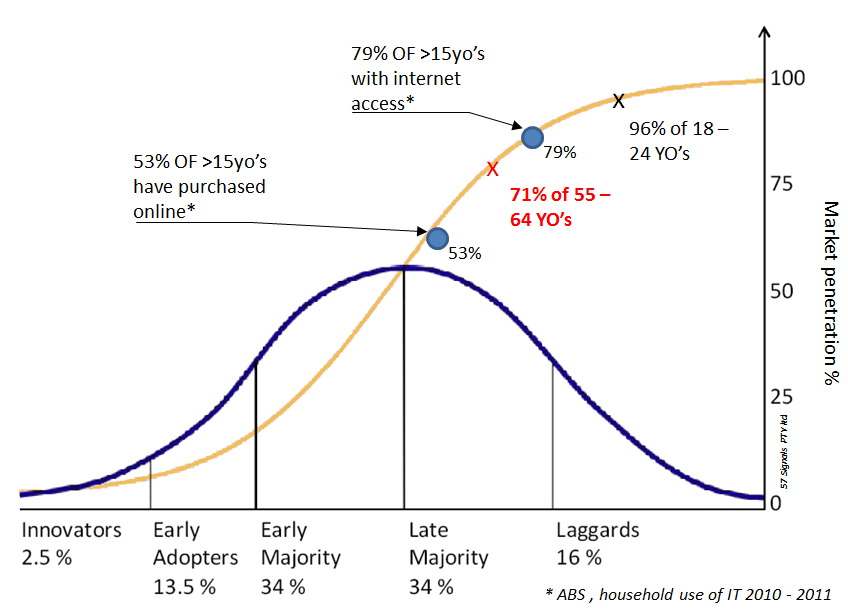
According to the Australian Bureau of Statistics, 79% of Australians over the age of 15 are online – meaning adoption is way past the Early Adopter phase (According to the Diffusion of Innovations curve) and well into the Late Majority – at 84% adoption only the Laggards are yet to join!

In terms of age profile, 96% of 18 – 24 Year Olds are already online, so new audience growth will mostly come from older age segments in the coming years. In the past two years, 55 – 64’s joined the web at almost twice the rate of their younger counterparts.
image

This new older audience presents an interesting opportunity, by nature they are more considered and loyal (and/or resistant to change), and have an appealing cash pile at their disposal.

Winning the over 55’s is hard though, often they rely on personal recommendations and will Trial only after careful consideration, but they are worth the effort.

So here are six tips for appealing to an older user:

  1. Encourage linger time, provide plain and simple T’s and C’s, lots of expansive detail
  2. Include testimonials, the more the better (including Facebook ads as below)
  3. Be sensitive with lifestyle shots, don’t alienate the older demo with youthful images, equally, avoid images of over 50’s, over 50’s think associate with people in their early 40’s!image
  4. Consider a larger, easy to read font
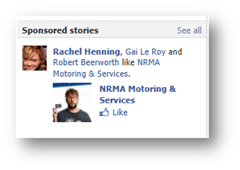
  5. Leverage Facebook ads such as the one shown here, “friends as fans” work as a testimonial
  6. Take care to provide a generous returns policy, over 50’s are considered and risk averse.

Group Buying Industry takes the wraps off its long awaited Code of Conduct

The Group Buying Industry in Australia has suffered some reputational damage through the conduct of some less than responsible industry players, in fact many Merchants and Customers tell us at Cudo that Group Buying sometimes resembles the wild west with shonky Group Buying startups offering dubious discounts on even more dubious experiences. This has to stop. Group Buying now represents a $500m industry in Australia and supports well over 1,000 employees. This is why at Cudo we felt compelled to act.

The Group Buying Industry Code of Conduct is being jointly announced today by AIMIA and ADMA and is an essential step towards ensuring a minimum standard of transparency and service from the participating Group Buying businesses and was called for by Cudo back in June of this year.

Although the long standing Cudo Satisfaction Guarantee means we are fully compliant with the Code from day one, we are delighted to be a founding signatory along with a small number of Leading Group Buying business, and hope that the majority of Group Buying businesses in Australia shape up and sign up to the Code.

How to maximise the impact of Price Discrimination

50 off

[This post originally appeared on the ADMA blog]

Businesses have been discriminatory since the dawn of time. Recognising that not all customers are equal is essential and provides the key to maximising the effects of supply and demand.

Making the best use of discriminatory pricing means that you need to identify the price sensitivity of each customer group and target them with an appropriate incentive. For example, how willing are they to do work or take risk in exchange for a discount.

Airlines are the masters of price discrimination and there is a lot to be learned from their approach. Granted airlines have the luxury of sophisticated modelling and real time pricing however your business can execute a similar strategy with limited fuss.

Think about airlines’ ticket pricing as a set of incentives and it may become clearer. Imagine the advertising headlines read something like this:

Book this seat months in advance and we can be sure the flight will sell well. In exchange for that insight and the non-refundable dollars you are willing to give us (that will then sit in our account to earn interest) we will give you a generous discount”

Or

We are eager to maximise the bums on seats on this flight and as such here is a substantial discount”.

Right now, your business probably has a series of ongoing campaigns designed to incentivise price sensitive customers to purchase. Offers such as “half price Tuesday”, “book early to save”, “book late and save” or “buy one get one free”. These are all effective discriminatory price strategies.

The key is to deeply understand both your “price sensitive customer” and your “marginal cost of sale” i.e. the true incremental cost of servicing one additional customer now that your fixed costs are covered. The likelihood is that each additional customer can be serviced profitably even if they only pay 30% of the full advertised rate. You can profitably take utilisation from 65% (which is the typical breakeven point) to >80% even if each new customer only pays 50% or less of the advertised rate. There is a risk of course. If you broadcast the discount too largely your full paying customers may hear about the lower rate, they may be annoyed or worse still hold back from purchasing, therefore cannibalising your base revenue stream. Learning how to target your “price sensitive customers” is essential to profitable price discrimination.

Data driven marketing solves each of the issues described above. Find ways to identify and reach the “price sensitive audience” (geography, prior buying behaviour, acquisition source) then serve discrete offers designed to encourage acquisition behaviour, such as switching from an existing provider, prepayment, bulk purchase or even to drive
out of the area. The level of incentive you offer should be generous; if your costs have been covered you can afford it. Ensure staff treat all customers equally and focus on providing a great customer experience that will maximise profit, loyalty and word of mouth recommendation.

Remember, “price sensitive customers” are savvy, not cheap. Reward them with great service and you will earn their loyalty, except next time they will pay full price – no discrimination required