Profiting from the fundamentals of Group Buying: part 1… Focus

image

Group Buying works for a reason, regardless of the service woes plaguing the industry (which have been driven by a combination of greed and inexperience, not the model itself) the principles behind Group Buying are sound. Over the next few posts, I will explain the key mechanics and position them in a series of non-Group Buying contexts.

There are six key mechanics inherent to the category that are designed to illicit an emotional response, such as an impulse purchase.image

This is the first of six posts I will write that describe those mechanics.

FOCUS ATTENTION ON ONLY A FEW OFFERS

Limiting promotional efforts to only 1 – 3 featured offers enhances the perception of those offers and likely uptake, minimising “noise” around those offers will further spotlight the chosen few. Featuring multiple offers on the other hand dilutes the “WOW” and runs the risk of Paradox of Choice effects.

Most email platforms will support controlled tests, such as sending one control group an EDM with multiple offers, one with the three best offers and one EDM with only a single “hero” offer.

Assuming the control conditions are sound, the likely outcome is that the Hero and “three best offers” EDMs will each provide a click through rate that is greater than the “multiple offers” EDM even though the multiple offers email included the featured offers from the other tests.

Finding the right balance is critical, and running controlled A/B and Multi Variant Tests will find that balance.

Take note, your Audience is growing old more quickly than you are!

image

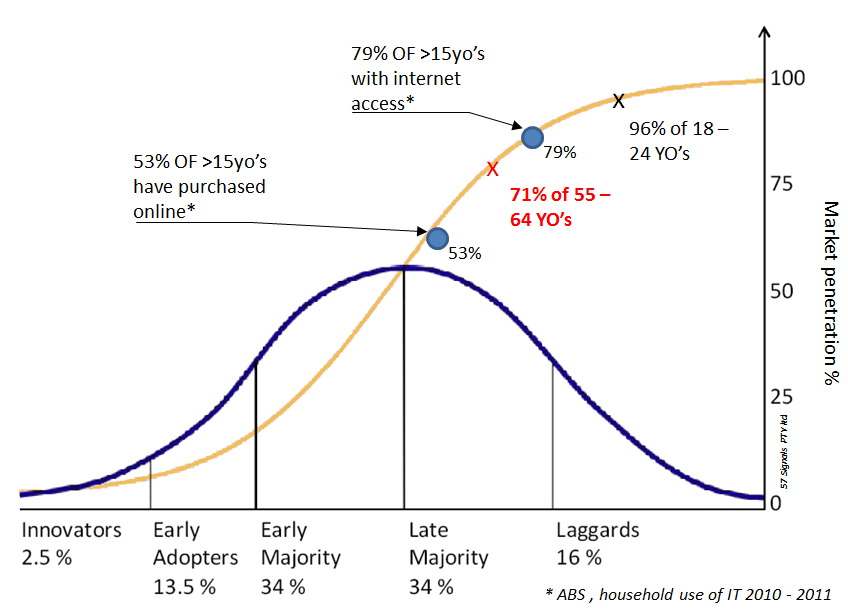
The average age of an Australian internet user is growing fast; catering for this shift is increasingly important.

According to the Australian Bureau of Statistics, 79% of Australians over the age of 15 are online – meaning adoption is way past the Early Adopter phase (According to the Diffusion of Innovations curve) and well into the Late Majority – at 84% adoption only the Laggards are yet to join!

In terms of age profile, 96% of 18 – 24 Year Olds are already online, so new audience growth will mostly come from older age segments in the coming years. In the past two years, 55 – 64’s joined the web at almost twice the rate of their younger counterparts.

image

This new older audience presents an interesting opportunity, by nature they are more considered and loyal (and/or resistant to change), and have an appealing cash pile at their disposal.

Winning the over 55’s is hard though, often they rely on personal recommendations and will Trial only after careful consideration, but they are worth the effort.

So here are six tips for appealing to an older user:

  1. Encourage linger time, provide plain and simple T’s and C’s, lots of expansive detail
  2. Include testimonials, the more the better (including Facebook ads as below)
  3. Be sensitive with lifestyle shots, don’t alienate the older demo with youthful images, equally, avoid images of over 50’s, over 50’s think associate with people in their early 40’s!image
  4. Consider a larger, easy to read font
  5. Leverage Facebook ads such as the one shown here, “friends as fans” work as a testimonial
  6. Take care to provide a generous returns policy, over 50’s are considered and risk averse.

The art of personal retailing, made easy Online

image

Pricing alone will never lead to a long term strategic advantage, only service quality and inspiration can.

I’m saddened by today’s retail landscape in Australia. Shop windows shout lowest price, when what I really need are inspirational gift ideas, good sales advice and the comfort that my dicky gift choices can be returned when they turn out to be just that, dicky!

Pricing is a consideration for sure but only in so much as the chosen item is inside or outside my budget, at which point the role of a retail assistant is to upsell upsell upsell!

At this time of year, the vast majority of retail spending is focused on gift buying. But in this world of consumerism on steroids, friends and family are increasingly hard to buy for – combine this with the paradox of choice we feel and no wonder the shelves remain stacked and the gifts received remain, er, dicky. Pricing, though, is rarely the issue.

The solution is probably right in front of me, a personal shopper! But who knows how to use one of those? In the world of online, a Personal Shopper is only a few clicks away. Punch in my budget, a broad description of the loved ones I’m buying for and bam, inspiration is at hand. Maybe my better-half gets an email with options to choose from that will better narrow the items presented back to the buyer, Buble or Gaga, Block colours or print, ebook or paper? Now I have items to choose from that make me look like the hero I am, and I can pick up in store to boot (time for that all-important upsell and gift wrapping service!)

Clearly these are difficult times, and Christmas is an expensive business, so the price conscious shopper with a gift in mind is looking for the best price available. But I don’t believe that is the whole story. By focusing on lowest price retail I worry that our biggest Branded retailers are on a race to zero, yet they’ll remain unable to compete with online – this is a lose lose for all. Online is the key to harvesting Signals for that personal experience, it’s the opportunity for Big Retail to take “personal retailing” to the next level; training consumers to think Online is all about Lowest price and best discount is to underwrite the death of Big Retail.

“Discount heavily and I will love you right now, inspire me with insights and ideas and great service and I will love you for ever”

Footnote:

Two stories in today’s SMH caught my eye, one announcing that Australia’s Retail legend Myer was launching it’s Boxing day sale today to online customers, and the other covering the Neiman Marcus Christmas catalogue (which has been available since 1926 and growing from strength to strength each year!) interesting contrast between growing retail and contracting retail.

Another story here from ninemsn, Harvey Normal now cannibalising its own revenues through offshore hosted online store, ug.