How to maximise the impact of Price Discrimination

50 off

[This post originally appeared on the ADMA blog]

Businesses have been discriminatory since the dawn of time. Recognising that not all customers are equal is essential and provides the key to maximising the effects of supply and demand.

Making the best use of discriminatory pricing means that you need to identify the price sensitivity of each customer group and target them with an appropriate incentive. For example, how willing are they to do work or take risk in exchange for a discount.

Airlines are the masters of price discrimination and there is a lot to be learned from their approach. Granted airlines have the luxury of sophisticated modelling and real time pricing however your business can execute a similar strategy with limited fuss.

Think about airlines’ ticket pricing as a set of incentives and it may become clearer. Imagine the advertising headlines read something like this:

Book this seat months in advance and we can be sure the flight will sell well. In exchange for that insight and the non-refundable dollars you are willing to give us (that will then sit in our account to earn interest) we will give you a generous discount”

Or

We are eager to maximise the bums on seats on this flight and as such here is a substantial discount”.

Right now, your business probably has a series of ongoing campaigns designed to incentivise price sensitive customers to purchase. Offers such as “half price Tuesday”, “book early to save”, “book late and save” or “buy one get one free”. These are all effective discriminatory price strategies.

The key is to deeply understand both your “price sensitive customer” and your “marginal cost of sale” i.e. the true incremental cost of servicing one additional customer now that your fixed costs are covered. The likelihood is that each additional customer can be serviced profitably even if they only pay 30% of the full advertised rate. You can profitably take utilisation from 65% (which is the typical breakeven point) to >80% even if each new customer only pays 50% or less of the advertised rate. There is a risk of course. If you broadcast the discount too largely your full paying customers may hear about the lower rate, they may be annoyed or worse still hold back from purchasing, therefore cannibalising your base revenue stream. Learning how to target your “price sensitive customers” is essential to profitable price discrimination.

Data driven marketing solves each of the issues described above. Find ways to identify and reach the “price sensitive audience” (geography, prior buying behaviour, acquisition source) then serve discrete offers designed to encourage acquisition behaviour, such as switching from an existing provider, prepayment, bulk purchase or even to drive
out of the area. The level of incentive you offer should be generous; if your costs have been covered you can afford it. Ensure staff treat all customers equally and focus on providing a great customer experience that will maximise profit, loyalty and word of mouth recommendation.

Remember, “price sensitive customers” are savvy, not cheap. Reward them with great service and you will earn their loyalty, except next time they will pay full price – no discrimination required

Why I don’t worry about Hitwise

As the CEO of a Group Buying business in the nascent and burgeoning category it was critical that I had a very clear view of marketing effectiveness, with Audience Engagement being the key indicator. There were a number of sources available to the team that purported to provide reliable Audience measurement and insights however I only depended on two to provide an accurate view, Omniture and Nielsen.

Alternative sources included Hitwise, Google Analytics and Alexa – Google Analytics is cheap/free but pretty unreliable and Alexa provides a Relative view only. Hitwise is the worst of the bunch though given their data collection methodology means it doesn’t represent the broader online population and worse still, it doesn’t necessarily reflect human activity!

Here are the two main issues with Hitwise data:

1. Hitwise does not measure individuals – it measures traffic.

This effectively means you could hit your website with bot traffic to boost your numbers and it would show as traffic in Hitwise. Nielsen Australia removed 50% of GroupOn Australia’s traffic in March because that traffic consisted largely of unsolicited clicks, meaning popups that appear as you close scurrilous ads (Congratulations, you have won $1,000,000!!!!!) – those clicks are still counted in Hitwise.

2. Hitwise doesn’t include key ISPs

Hitwise harvest data from partnering ISP’s, however Australia’s two largest ISP’s BigPond and Optus don’t participate. This is major a concern as a large proportion of internet users (about 58%) are not reflected in their data. This is a particular problem for a business like Cudo given its mainstream audience, and mainstream Australia do not typically use fringe ISPs.

Nielsen was recently selected as the official measurement partner of the Australian IAB, in their press release they said:

With the endorsement of Nielsen Online Ratings, IAB Australia is identifying people-based metrics, as opposed to browser-based, as the best and preferred online audience measurement system for the Australian online advertising industry.

This is the nub of the problem. TechCrunch called it out almost two years ago.

At Cudo we didn’t care about browsers for obvious reasons, we cared about people, they still do, like the 1,000,000 plus Australians who go to cudo.com.au each and every month, I couldn’t give a monkeys how many Bots swing by!

GroupOn here in Australia, Bait and Switch is tactic #1

I was disappointed to hear about GroupOn’s Bait and Switch issue concerning the Valentine’s Day offer with FTD, however I immediately jumped to their defence.

A large part of Cudo’s operation is focused on ensuring that the offers we provide are 100% genuine, not just because we advertise on TV and are subject to rigorous standards, but because we believe the long term success of Cudo is hinged upon trust.

Our Merchant partners have to trust that Cudo will do the right thing by them by providing a great audience of new customers, broad brand promotion as described and payment in full within five days. And our members have to trust that Cudo is all about genuine no-brainer offers!

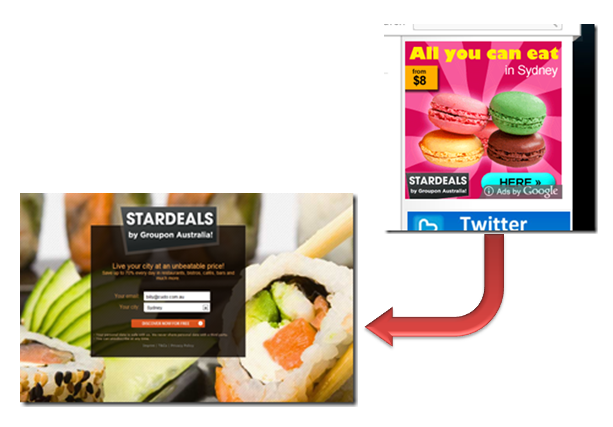
GroupOn must also have a whole team of people focused on ensuring that offers are “as stated”, hence why I jumped to their defence. However after seeing the following “all you can eat” ad, I am no longer sure!

Clicking on the ad for $8 all you can eat Macaroons takes you to a sign-up page, no such offer exists.

Deceptive. Yes. Bait and Switch. I think so.

Unless I am missing something, this type of Bait and Switch advertising is way out of line and threatens to damage the market as a whole. One thing is for sure, Cudo will never resort to these desperate tactics.

image