How to maximise the impact of Price Discrimination

50 off

[This post originally appeared on the ADMA blog]

Businesses have been discriminatory since the dawn of time. Recognising that not all customers are equal is essential and provides the key to maximising the effects of supply and demand.

Making the best use of discriminatory pricing means that you need to identify the price sensitivity of each customer group and target them with an appropriate incentive. For example, how willing are they to do work or take risk in exchange for a discount.

Airlines are the masters of price discrimination and there is a lot to be learned from their approach. Granted airlines have the luxury of sophisticated modelling and real time pricing however your business can execute a similar strategy with limited fuss.

Think about airlines’ ticket pricing as a set of incentives and it may become clearer. Imagine the advertising headlines read something like this:

Book this seat months in advance and we can be sure the flight will sell well. In exchange for that insight and the non-refundable dollars you are willing to give us (that will then sit in our account to earn interest) we will give you a generous discount”

Or

We are eager to maximise the bums on seats on this flight and as such here is a substantial discount”.

Right now, your business probably has a series of ongoing campaigns designed to incentivise price sensitive customers to purchase. Offers such as “half price Tuesday”, “book early to save”, “book late and save” or “buy one get one free”. These are all effective discriminatory price strategies.

The key is to deeply understand both your “price sensitive customer” and your “marginal cost of sale” i.e. the true incremental cost of servicing one additional customer now that your fixed costs are covered. The likelihood is that each additional customer can be serviced profitably even if they only pay 30% of the full advertised rate. You can profitably take utilisation from 65% (which is the typical breakeven point) to >80% even if each new customer only pays 50% or less of the advertised rate. There is a risk of course. If you broadcast the discount too largely your full paying customers may hear about the lower rate, they may be annoyed or worse still hold back from purchasing, therefore cannibalising your base revenue stream. Learning how to target your “price sensitive customers” is essential to profitable price discrimination.

Data driven marketing solves each of the issues described above. Find ways to identify and reach the “price sensitive audience” (geography, prior buying behaviour, acquisition source) then serve discrete offers designed to encourage acquisition behaviour, such as switching from an existing provider, prepayment, bulk purchase or even to drive
out of the area. The level of incentive you offer should be generous; if your costs have been covered you can afford it. Ensure staff treat all customers equally and focus on providing a great customer experience that will maximise profit, loyalty and word of mouth recommendation.

Remember, “price sensitive customers” are savvy, not cheap. Reward them with great service and you will earn their loyalty, except next time they will pay full price – no discrimination required

EDLP or not, retailers are out of control!

What’s wrong with the picture below?

Photo_080798BA-A992-3405-BE49-18BADCBF466C

The clue is in the row of heads above the shelves of candy.

This discount retailer has positioned hundreds of impulse items along two sides of this isle designed to tempt shoppers while they queue for a checkout.

By my reckoning, the shopper you can see at the top of the picture has a 15 minute wait ahead of them, providing lots of opportunity for the retailer to maximise Basket size.

The longer the queue, the greater the likelihood folks will be upsold. This retailer has knowingly implemented a strategy to reward themselves for poor service. That is broken.

Regardless of their EDLP strategy, poor service shouldn’t be part of it. Institutionalising crappy service is outrageous, deriving benefit has to be the shortest of short term views.

Group Buying – Smoothing demand to meet supply

A Targeted Voucher Program (like Group Buying) does more than simply increase brand awareness and consumer demand, it smooths demand to make best use of the available Supply, combine this will upsell opportunities and future loyalty and the returns will continue to flow well beyond the life of the promotion.

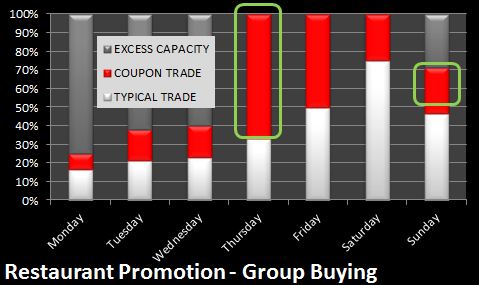
Running an above the line Brand promotion will make the target business top of mind for a new set of potential customers, hopefully creating lots of new Demand albeit the profile of that demand is likely to look a lot like existing demand, just more of it! For restaurants, that means what little availability there is on a Friday or Saturday will go first, and once they are gone, customers will be unlikely to settle for a midweek or Sunday slot instead, squandering the marketing investment and the opportunity to introduce your business to a new audience.

image

A Targeted Voucher Program is fundamentally different. Why? Typically, when a someone calls a restaurant to book a table they are planning an evening out, they have an evening in mind and are looking for a suitable restaurant to meet their needs, if their preferred night is full, they’ll call the next restaurant on their list; however when they call with a Voucher, they already have a restaurant in mind, they just need to find a suitable evening to redeem it, they have already made a commitment to your business after all (and paid upfront too!)! Voucher holders are willing to book well in advance to redeem their voucher, something an average patron is unlikely to do and upselling your Voucher holder to a weeknight at this point is the first step toward smoothing Demand.

At Cudo, we hear often from business owners that occupancy is significantly improved on Thursdays and Sundays as a direct result of running a promotion on cudo.com.au. The more popular the offer, the greater the impact is on weekday trade, yielding a significant gain in efficiency for the business overall. 

image

Making the most of this type of promotion is the role of the featured business, they have to embrace the promotion and the new interest generated, train their staff to upsell and make the most of customer loyalty.

But irrespective of how small the gap is between supply and demand, combine a Targeted Voucher Program with a booking system and you have a very powerful way to improve short to medium term occupancy – make the most of the Program and it will have a lasting impact on your business.