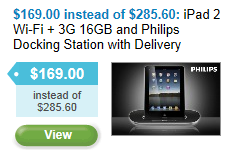
GROUPON are at it again!

Come on guys, you are clearly not idiots, so why do you think it is ok to engage in misleading advertising tactics to score a few email clicks and possibly screw a few unsuspecting customers out of $800?

Groupon.com.au today advertised an iPad 2 with Wi + 3G and a docking station with delivery for $169.00 knowing full well that the actual price for well over $800! This is not ok. Having already apologised for dodgy Bait and Switch advertising I’m surprised at their willingness to ramp it up a notch with misleading offers.

image

Groupon defended its actions via Smart Company by saying that they had “a technical limitation”, they said  “we are one of a very few sites that can do multiple deals. But what we cannot do is show that in the email – it’s simply not possible.”” which meant they couldn’t accurately reflect the real price of the offer and were somehow forced to show a misleading one instead?

This is exactly the type of behaviour we will aim to stamp out through participation in the Group Buying Industry Code of Conduct – let’s hope we agree to a Code before this burgeoning industry’s reputation is irrevocably harmed by tactics like these.

How to maximise the impact of Price Discrimination

50 off

[This post originally appeared on the ADMA blog]

Businesses have been discriminatory since the dawn of time. Recognising that not all customers are equal is essential and provides the key to maximising the effects of supply and demand.

Making the best use of discriminatory pricing means that you need to identify the price sensitivity of each customer group and target them with an appropriate incentive. For example, how willing are they to do work or take risk in exchange for a discount.

Airlines are the masters of price discrimination and there is a lot to be learned from their approach. Granted airlines have the luxury of sophisticated modelling and real time pricing however your business can execute a similar strategy with limited fuss.

Think about airlines’ ticket pricing as a set of incentives and it may become clearer. Imagine the advertising headlines read something like this:

Book this seat months in advance and we can be sure the flight will sell well. In exchange for that insight and the non-refundable dollars you are willing to give us (that will then sit in our account to earn interest) we will give you a generous discount”

Or

We are eager to maximise the bums on seats on this flight and as such here is a substantial discount”.

Right now, your business probably has a series of ongoing campaigns designed to incentivise price sensitive customers to purchase. Offers such as “half price Tuesday”, “book early to save”, “book late and save” or “buy one get one free”. These are all effective discriminatory price strategies.

The key is to deeply understand both your “price sensitive customer” and your “marginal cost of sale” i.e. the true incremental cost of servicing one additional customer now that your fixed costs are covered. The likelihood is that each additional customer can be serviced profitably even if they only pay 30% of the full advertised rate. You can profitably take utilisation from 65% (which is the typical breakeven point) to >80% even if each new customer only pays 50% or less of the advertised rate. There is a risk of course. If you broadcast the discount too largely your full paying customers may hear about the lower rate, they may be annoyed or worse still hold back from purchasing, therefore cannibalising your base revenue stream. Learning how to target your “price sensitive customers” is essential to profitable price discrimination.

Data driven marketing solves each of the issues described above. Find ways to identify and reach the “price sensitive audience” (geography, prior buying behaviour, acquisition source) then serve discrete offers designed to encourage acquisition behaviour, such as switching from an existing provider, prepayment, bulk purchase or even to drive
out of the area. The level of incentive you offer should be generous; if your costs have been covered you can afford it. Ensure staff treat all customers equally and focus on providing a great customer experience that will maximise profit, loyalty and word of mouth recommendation.

Remember, “price sensitive customers” are savvy, not cheap. Reward them with great service and you will earn their loyalty, except next time they will pay full price – no discrimination required

Cudo and Spreets launch a framework for a Group Buying Code of Conduct!

Today, Cudo announced the launch of a draft Code of Conduct for for the Group Buying industry and a framework to complete the code in partnership with Spreets and a number of industry bodies, including ADMA, AIMIA, Telsyte and others.

This is no PR stunt, this is an important step that was born out of necessity. The growth of the Group Buying industry in Australia has lead to more than twenty companies starting daily deals websites; this growth brings real risk to merchants, to consumers and to the category as a whole. Once agreed though, the Code will bring a set of principles that will go a long way to protecting Merchants and consumers from that risk.

Cudo and Spreets as industry leaders at least recognise the importance of putting merchants and members first, ensuring the group buying experience continues to be strategically sound for merchants, and enjoyable and worthwhile for members. As the category grows, our introduction of this voluntary Code of conduct provides a framework from which to implement some of the fundamentals of good group buying and promote best practice.

We have invited our Group Buying competitors to get involved in the development of the code and sign up to the finished document, I sincerely hope they do – many existing Group Buying businesses will have to mend their ways if they are to sign up of course, let’s hope they do that too!

The draft Code of Conduct is as follows:

Our commitment to members is to:
1. Always offer you great deals – genuine discounts on quality products and services from first class merchants
2. Never engage in misleading advertising, such as advertising specific discounts or products that don’t actually exist (known as ‘Bait and Switch’)
3. Make our deal descriptions and terms & conditions clear using plain English so you know what to expect in return for your voucher. Where exclusions exist, they will be equally clear using plain English and will never be intentionally misleading
4. Make our website terms and conditions clear and in plain English so you know what to expect from your experience with our sites
5. Respect your privacy at all times and abide by the Privacy Policy you agreed to when you joined the site
6. Respect your email account at all times, taking measures to protect it from hacking or other fraudulent use
7. Work with our merchants to make sure you can easily redeem your voucher and that you are treated as good as or even better than a typical full paying customer
8. Provide responsive and helpful customer support and service – seeking to fully understand and resolve your issues
9. If you’re not fully satisfied with your experience, we’ll seek to understand why, address the issues and, if your issue cannot be resolved, provide you with a full refund or credit
10. Do what we say we’re going to do, every time

Our commitment to merchants is to:
1. Work with you and your team to make your group buying promotion as successful as possible
• Help you package and price the right deal for your business
• Help you prepare for the increase in customers
• Help you manage the increase in demand including capping your offer as necessary
• Help you maximise your up-sell opportunity to enhance the experience of new customers at your business
• Help you get customers coming back
2. Provide you with clear payment terms
3. Provide fast, effective, personal customer service through a dedicated account management model
4. Do what we say we’re going to do, every time