
Good commercial sense underpins sustainable philanthropy

BC Logo new

In 1999 the ever cheery Brits (of which I’m one) were flabbergasted when their #1 Son Richard Branson lost a bid for the National Lottery. His manifesto for the People’s Lottery was based on it being run as a Not for Profit meaning that profits would be provided as donations to the lottery commission over and above the standard fun-raising efforts of the National Lottery. Even though these additional donations would exceed $1bn each year the Lottery Commission said no, instead they chose Camelot who had no such altruism in mind.

Surely something’s afoot, why would the Purpose driven Lottery Commission choose greedy toes Camelot over goody two shoes Branson? Isn’t that Greed before Good?

Not that simple.

The Lottery Commission figured that without the benefit of a Profit Engine behind Lottery Ticket sales, they’d be worse off taking the $1bn contribution from the Virgin effort. That their interests would be misaligned and the overall donation pool would be smaller as a result. A decision that has since been vindicated several times over.

If the collective interests are balanced, doing good doesn’t have to be unprofitable.

Recently I co-founded a business called BeyondCover. On one hand BeyondCover is an Insurance reseller for Global Underwriter QBE, selling CTP (The mandatory Motor cover in Australia), General Motor and Travel Insurance, on the other hand it raises money for causes by rewarding Cause partners when they introduce a new Insurance Customer.

The key to having the right incentives in place lies within the nature of Philanthropists. People who regularly support Good Causes are good people, they take fewer risks, cause fewer accidents and pay their bills on time. They make pretty good Insurance customers too!
Big companies can’t win, time to get down and dirty!

Reinvention is bloody hard, rarely has a big business managed to pivot wholesale to a new them without causing a catastrophic collapse of their core along the way. History is littered by once great corporations hollowed by their failure to recognise the need for reinvention.

But this isn’t a cautionary tale featuring Kodak and their resistance to the Digital age, although that is a good story! This cautionary tale concerns those businesses that recognise the need for change but fail, fail because their big company DNA rejects the wide eyed organism growing within.

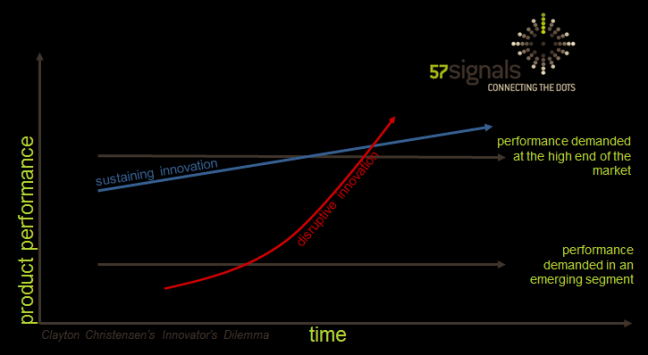
Clayton Christiansen describes the issue as the Innovators Dilemma. The central theme of his argument is that big businesses innovate within the constraints of their own expectations. Big business’ expectations demand an aggressive and predictable return on capital as well as a degree of polish that small businesses and startup entrepreneurs happily live without.

Those expectations limit their ability to innovate to the Sustaining kind only, meaning incremental improvements that result in incremental bottom line impacts. The new breed of competitor, i.e. startups, don’t live with those constraints and can therefore galvanise their new business around an untested way forward.

Innovation favours the brave and startups are certainly brave. Entrepreneurs often leave themselves with little to lose and can afford to turn existing models on their head in a effort to break through. And breakthrough they do.

In the past big corporate goliaths still won though, regardless how stilted their innovation; barriers to entry and scale benefits afforded them a dependable lead against newer foes. But today’s David is better equipped. They have the triple whammy benefits of low cost of capital, cheap scalable technology and affordable access to a large audience; also, this new wave of Disruptive Innovation is easily embraced by customers so should be feared by slow to move businesses and their shareholders alike. Boardrooms have too much as stake to stay ignorant to the Breakthrough Innovation occuring around them, so breaking through the innovators dilemma will have to happen eventually. But there is a great risk of too little too late.

Corporate leaders have to do more to embrace breakthrough thinking and create structures to do so. Establishing a mini startup fund and incubator for internal entrepreneurs and staff incentives to encourage broader thinking are essential steps. Communicating to the broader business the importance of supporting those innovations by accepting the quick and dirty necessity of breakthrough thinking is also essential if rejection of the new organism is to be avoided.

Is your business gearing up for in-car Internet?

ABI Research are forecasting a significant growth in Internet Enabled cars, with 50m vehicles sold by 2017 with native Internet connectivity.

In car connectivity is already broadly available with smartphone-dependent products like HondaLink available in most markets today. However like any new technology, the real breakthrough comes when new applications are developed by a broader ecosystem, which, as far as we can tell, is yet to happen.

It’s quite possible that 30 – 40% of new cars sold in Australia will be Internet Enabled with 5 years, yet few business have connected cars in their 3 year plan.